An example: the calibration round
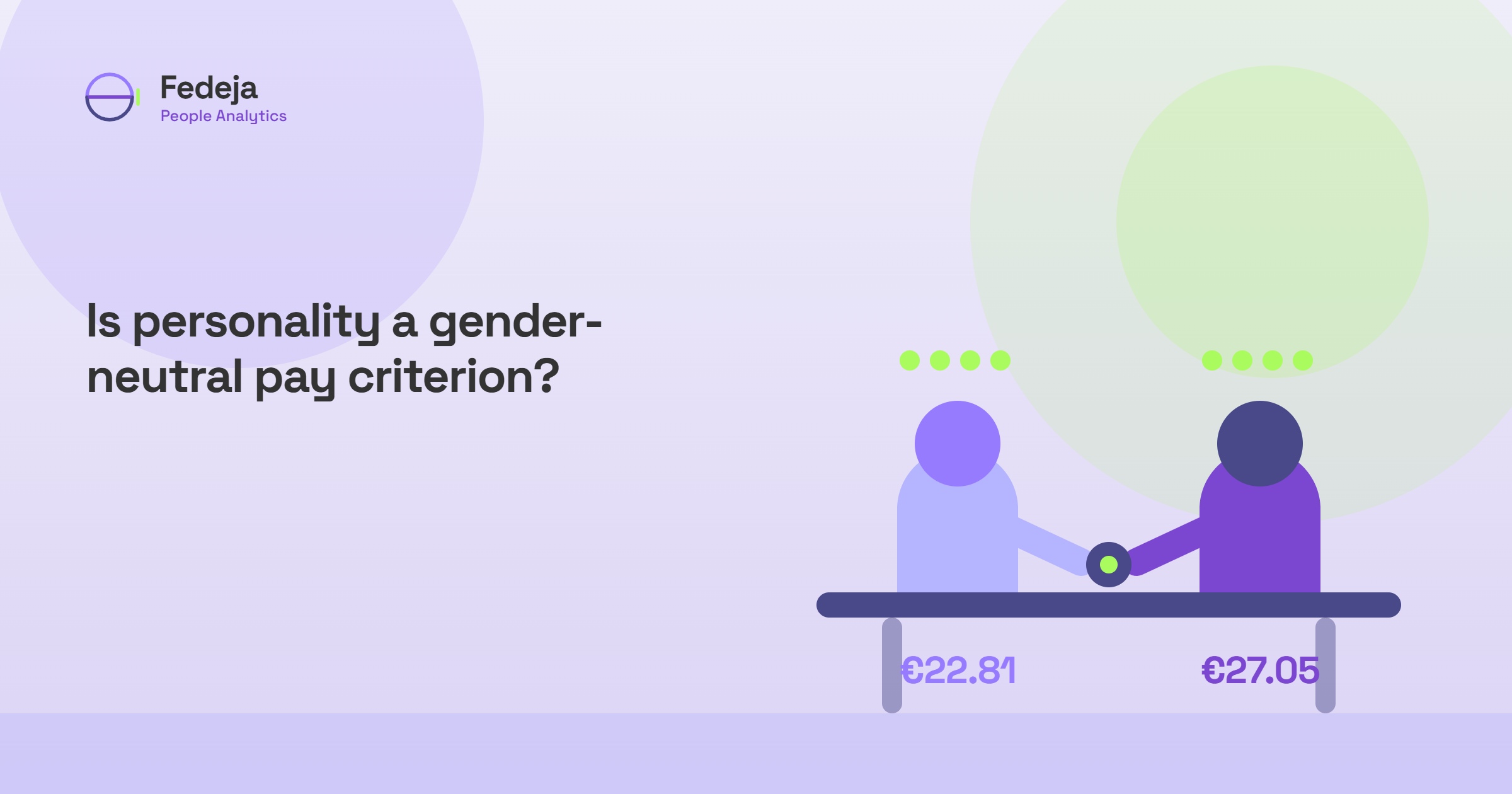
A constructed example of something that happens in much the same way in many organisations: in the annual calibration round, two team leads sit side by side, the same pay grade, comparable results, both teams have met their targets. Alongside the targets, the appraisal form also asks about "assertiveness" and "executive presence". Of him it is said that he comes across as confident and holds his position even towards the division head. Of her it is said that she is reliable, cooperative and keeps the team together. He moves one step up the salary band; she receives the development goal "show more presence". Nobody in that round decided to pay for personality; it was simply on the form, and the form applied to both.
Whether gender-neutral pay criteria are in place is decided at exactly such points, and not by the question of whether the same criterion applies to everyone but by whether the same criterion has the same effect on everyone. DIW Berlin, the German Institute for Economic Research, has examined this question for personality traits, and the answer is clear [1].
Personality has a price, and it is not the same for everyone
Using data from the German Socio-Economic Panel (SOEP), a long-running household survey, DIW examined in its Weekly Report 9/2026 how personality traits relate to gross hourly wages, holding education, work experience and industry constant. Emotional stability, meaning self-confidence, stress resilience and composure, goes with around 2% higher hourly wages; agreeableness with around 2% lower. The magnitude is comparable to that of cognitive skills [1] [2].
The finding that matters for pay systems sits behind this: both relationships are about twice as strong for men as for women. For emotional stability, men receive a premium of around 2%, women around 1% [1] [3]. Since women on average score higher on agreeableness and men on emotional stability, the same mechanism works twice in the same direction, and it thereby contributes to Germany's gender pay gap of 16% [4], after the usual explanatory factors have been controlled for. DIW reads the differences as an expression of social norms: the same trait is rewarded in men and hardly at all in women. Its recommendation is accordingly to dismantle stereotypes, for instance through more women in leadership positions and more men in female-dominated occupations [1].
One qualification belongs here, because it corrects the magnitude upwards rather than downwards: "holding education, work experience and industry constant" is a regression statement, and industry and educational path can themselves be the result of gender norms. Whatever sits in those control variables has been netted out, not disproved.
What the pay analysis sees and what it does not
A pay analysis works with what the systems hold: pay grade, function, experience, appraisal rating, salary. The appraisal rating is a result whose making the analysis does not see. If "executive presence" has flowed into the rating and the rating into the salary, then the personality premium is contained in the dataset but nowhere as a variable of its own. It sits inside a control variable that looks formally gender-neutral and disappears at the moment the model controls for performance. What is not measured does not exist for a model, and what is hidden inside another variable exists in the report as an explanation, not as a finding.
That is why searching for the premium in the regression is of little use. It arises earlier, on the form, in the calibration round, in the line manager's salary recommendation, and that is also where it can be found: by looking at the criteria themselves and at whether they describe what the job demands or how someone comes across while doing it.
Article 4 requires gender-neutral pay criteria, and personality is not on the list
Article 4 of the EU Pay Transparency Directive requires pay structures to be based on objective, gender-neutral criteria, and names them: skills, effort, responsibility and working conditions. Article 6 obliges employers to make the criteria used for pay setting and pay progression accessible, and those criteria too must be objective and gender-neutral [5]. Personality is on neither list, and yet it appears in almost every appraisal form, as "assertiveness", "presence" or "executive poise". These are the points where a premium enters pay that nobody decided on and that, once it sits inside the appraisal rating, is no longer recognisable as a personality premium in any pay analysis.
That appraisal criteria may have to be justified is not a new requirement, but the threshold for it has become lower. Since the judgment of the Federal Labour Court (Bundesarbeitsgericht, BAG), Germany's highest court for employment matters, of 23 October 2025 (8 AZR 300/24), a single pairwise comparison is enough to trigger the presumption of pay discrimination [6]. The explanation that the male colleague simply comes across as more confident then has to hold up in court, and whether it does is no longer decided by the HR department.
In closing
What follows is not spectacular: go through appraisal forms, promotion criteria and salary-round guidelines for personality-based wording and, wherever it appears, replace it with requirement-based wording, that is, with what the job demands rather than how someone comes across while doing it. In the calibration round from the beginning, this would have an unremarkable consequence: instead of "executive presence", the form would say something like "explains decisions to superiors and clients in a way they can follow", and then someone would have to describe what he did and what she did, instead of describing how each of them came across.
Frequently asked questions
1. Which pay criteria count as gender-neutral under the EU Pay Transparency Directive?
Article 4 names skills, effort, responsibility and working conditions as the criteria by which the value of work is to be determined; Article 6 requires the criteria for pay setting and pay progression to be objective and gender-neutral and to be made accessible to workers [5]. Behavioural attributes such as "presence" are not among them.
2. Isn't personality simply part of performance?
According to the DIW data, the relationship between personality and pay is about twice as strong for men as for women [1]. A criterion that is paid differently for the same trait does not measure performance but the impression a person makes on those assessing them. A performance criterion describes the result of the work, not the demeanour while doing it.
3. What did the Federal Labour Court decide in 8 AZR 300/24?
Under the judgment of 23 October 2025, a single comparison with a better-paid person of the other sex is sufficient to establish the presumption of pay discrimination; the employer then has to show that the difference rests on other, objective grounds [6]. How far the decision reaches in an individual case is a question for legal advice.
Sources
[1] DIW Berlin, Weekly Report (Wochenbericht) 9/2026: Gender Pay Gap: Persönlichkeitsmerkmale und Löhne hängen bei Frauen und Männern unterschiedlich zusammen (personality traits and wages are related differently for women and men; in German). https://www.diw.de/de/diw_01.c.1000775.de/publikationen/wochenberichte/2026_09_1/gender_pay_gap__persoenlichkeitsmerkmale_und_loehne_haengen_bei_frauen_und_maennern_unterschiedlich_zusammen.html
[2] DIW Weekly Report 9/2026 as PDF. https://www.diw.de/documents/publikationen/73/diw_01.c.1000729.de/26-9-1.pdf
[3] DIW Berlin, press release: Emotionale Stabilität geht bei Männern eher mit höheren Löhnen einher als bei Frauen (in German). https://www.diw.de/de/diw_01.c.1001048.de/gender_pay_gap__emotionale_stabilitaet_geht_bei_maennern_eher_mit_hoeheren_loehnen_einher_als_bei_frauen.html
[4] Federal Statistical Office (Destatis), press release no. 453 of 15 December 2025: Gender Pay Gap 2025 unverändert bei 16 % (gender pay gap unchanged at 16%). https://www.destatis.de/DE/Presse/Pressemitteilungen/2025/12/PD25_453_621.html
[5] Directive (EU) 2023/970 of 10 May 2023 (Pay Transparency Directive), in particular Articles 4 and 6. https://eur-lex.europa.eu/eli/dir/2023/970/oj/eng
[6] Federal Labour Court (Bundesarbeitsgericht, BAG), judgment of 23 October 2025, 8 AZR 300/24.
[7] PTA IN LOVE (1 July 2026): Gender Pay Gap: Auch Persönlichkeit beeinflusst das Gehalt (secondary report; in German). https://www.pta-in-love.de/gender-pay-gap-auch-persoenlichkeit-beeinflusst-das-gehalt/