The gender pay gap in health and care: the WHO/Europe figures
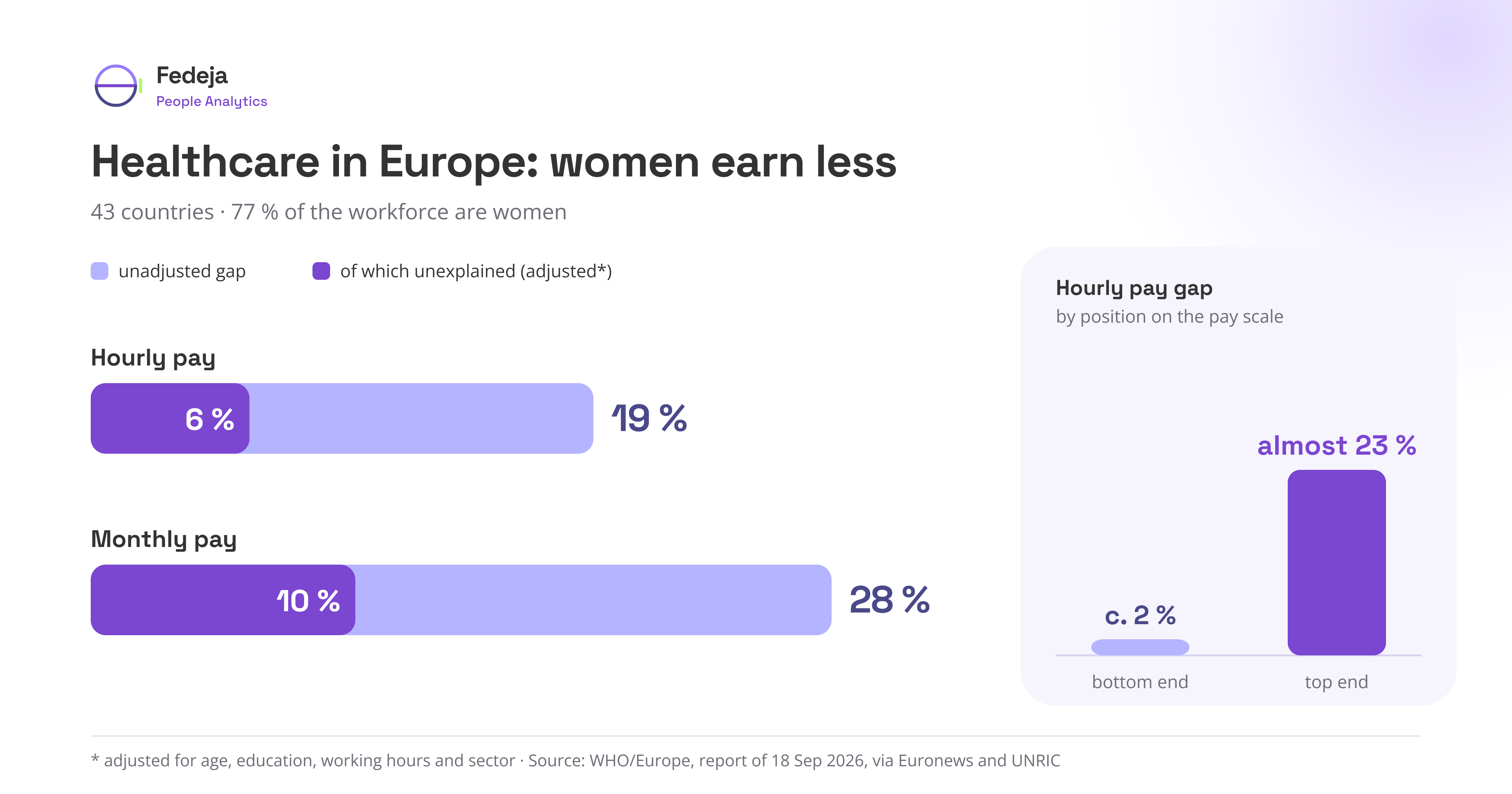
According to the report, women make up 77 % of the workforce in the health and care sector, and they earn 19 % less per hour than men in the same sector; on a monthly basis the gap is 28 per cent [1] [2]. Monthly pay reflects not only the hourly rate but also the number of paid hours, so the two figures do not measure the same thing.
Before comparing with your own organisation, note a limitation the headline leaves out. The WHO European Region extends beyond the European Union and includes, among others, the Russian Federation, Kyrgyzstan, Norway and Switzerland [1]. The 19 % is therefore neither an EU figure nor a German one, and the reports on the study do not give a figure for Germany. Anyone who places their own figure next to it is comparing a single employer with the average of 43 very different labour markets.
What the adjusted 6 % measures
Once age, education, working hours and whether someone works in the public or private sector are taken into account, the gap falls, according to the report, to 6 % in hourly pay and 10 % in monthly pay [1] [2]. This remainder is not explained by the four characteristics recorded, which is not the same as inexplicable, because its size depends on which characteristics went into the calculation. According to the reports, occupation and skill level are not among them [1] [2].
This is where a mix-up is easy to make. Germany's Federal Statistical Office (Destatis) also reports an adjusted gender pay gap of 6 per cent for Germany [4], against an unadjusted gap of 16 % [3]; but that adjustment includes occupation, industry and skill level [4]. The two sixes come from different models with different characteristics, and the fact that they match is coincidence. Both are subject to what Destatis states about its own figure: an adjusted gap must not be equated with pay discrimination [4]. Every characteristic a model controls for can itself be the result of disadvantage, and working hours are the best-known example, because they reflect the unequal distribution of care responsibilities [7].
Around 2 % at the bottom, almost 23 % at the top
The distribution says more than the remainder. At the lower end of the pay scale the gap is around 2 % according to the report, at the upper end almost 23 % [1]. An average of 19 % therefore describes neither end particularly well: for employees at the bottom it overstates the gap, for those at the top it understates it.
This is the director of nursing's first question, and the Pay Transparency Directive has a dedicated instrument for it. Alongside the pay gap as a mean and as a median, Art. 9 requires the proportion of women and men in each pay quartile [5]. If you divide the workforce by pay level into four groups of equal size and count in each, you see whether women are as well represented in the top quarter as in the bottom one; and if mean and median are far apart, that tells you whether the gap sits across the whole workforce or at the top [7].
What no pay gap report shows
The report also looks beyond the sector. According to it, managers in health care earn EUR 22.00 per hour, compared with EUR 24.70 in comparable roles in other sectors, and the more a job is dominated by women, the lower it is paid [1] [2]. The two euro amounts compare sectors, not women and men, and the reports on the study do not say how a euro figure is derived across 43 countries, many of which use a different currency.
For methodology, the finding behind this is nevertheless the most important in the report. A pay gap report under Art. 9 compares women and men within one employer, and it takes the grading of every job as given [5]. A regression does not ask why the head of a ward sits in one pay grade and the head of facilities management in another; the grading is its input [7]. What is not measured does not exist for a model: if a job performed predominantly by women is valued lower as a whole, this shows up in no gap within the category, because everyone there is graded the same.
This is the director of nursing's second question, and it can only be answered outside the calculation, namely in job evaluation. For this, Art. 4 of the Directive requires pay structures in which equal work and work of equal value are assessed on the basis of objective, gender-neutral criteria [5]. Beyond the individual employer, it allows comparisons where a single source establishes the pay conditions (Art. 19) [5]; the report under Art. 9 nevertheless covers only your own organisation.
What this means for the pay gap report
WHO/Europe recommends making pay gap reporting mandatory and breaking down pay data in more detail, and its most far-reaching recommendation is to revalue health and care work [1]. These are recommendations from a regional office, not legal obligations. The obligations under the Directive, in turn, only apply to private employers once the national transposition law is in place; the Directive provides that employers with 150 or more employees report for the first time by 7 June 2027 [5] [6].
For employers in health and social care, two things make sense regardless, because they are what makes your own figure readable: separating the pay gap by pay level, and recording the criteria by which the jobs predominantly done by women are evaluated.
In conclusion
The managing director's question of whether the figure is high can only be answered approximately with the WHO/Europe report, because the 19 % is an average across 43 countries and says little about either the lower or the upper end of the pay scale [1]. The director of nursing's two questions lead further, and the pay gap report answers only the first of them, provided it is read by quartile.
This article assesses the report from a pay analysis perspective and does not constitute legal advice.
Frequently asked questions about the gender pay gap:
1. How large is the gender pay gap in health care?
According to a WHO/Europe report of 18 September 2026, women in the health and care sector in 43 countries of the WHO European Region earn 19 % less per hour and 28 % less per month than men; they make up 77 % of the workforce [1] [2]. The figures apply to the region as a whole, which extends beyond the EU, and are not German figures.
2. What does the adjusted gap of 6 % in the WHO/Europe report mean?
It is the difference in hourly pay that remains once age, education, working hours and public or private sector are taken into account; for monthly pay it is 10 per cent [1] [2]. Occupation and skill level are not part of this calculation, which is why the figure cannot be compared with the adjusted gender pay gap of Germany's Federal Statistical Office, which is also 6 % [4]. In both cases the remainder denotes what the recorded characteristics do not explain, not a rate of discrimination.
3. Does the pay gap report under the Pay Transparency Directive show whether care work is undervalued?
No. The report under Art. 9 compares women and men within one employer and adopts the existing grading of jobs [5]. Whether a job performed predominantly by women is appropriately valued compared with others is determined by job evaluation based on objective, gender-neutral criteria, as required by Art. 4 [5].
Sources:
[1] UNRIC, 18.09.2026: Health workers earn less if they're women (reproduces the WHO/Europe press release).
[2] Euronews (German), 18.09.2026: WHO warnt: Frauen tragen Europas Gesundheitswesen, verdienen aber 19 Prozent weniger.
[3] Federal Statistical Office (Destatis), press release no. 453 of 15.12.2025: Gender Pay Gap 2025 unverändert bei 16 % (in German).
[4] Federal Statistical Office (Destatis), Gender Pay Gap: Frequently asked questions (adjusted and unadjusted, limits of interpretation).
[6] CMS Legal, EU Pay Transparency Directive: Comprehensive reporting obligations for companies (deadlines and thresholds).
[7] Fiodarava, Julia: How much discrimination does the methodology predetermine? Blog of Fedeja People Analytics GmbH, in German (over-control, mean and median, grading as regression input).